Warehouse snow removal starts with the truck court and dock aprons, not the car lot. Crews clear drive lanes and apron areas first so trucks keep moving, work around parked trailers without striking landing gear, keep snow away from dock drains and fire lanes, and sequence the work around shift changes. Along the I-78, Route 100, Route 33 and I-81 corridors, that plan should be set before the first storm.
Why warehouse snow work is different
The Lehigh Valley became one of the East Coast's biggest logistics hubs in a short time. Lehigh Valley Public Media reported in 2024 that about 44 million square feet of industrial and warehouse space was approved in Lehigh and Northampton counties from 2015 through 2023, according to the Lehigh Valley Planning Commission, with 8.4 million square feet completed in 2021 alone.
Those buildings sit on sites that look nothing like a shopping center. Truck courts are wide open concrete or asphalt fields where tractor trailers turn, back and park. Snow has to be moved without blocking docks, burying trailers or piling up where a yard truck needs to swing. And the building rarely closes, so the crew is working around live traffic for most of the storm.
The corridors where it matters most
Warehouse snow work in this region concentrates along a few corridors. Each has its own character, and a contractor should know which one your site is on.
- Route 100 and I-78 in Upper Macungie Township, around Fogelsville, Trexlertown and Breinigsville: dozens of large distribution buildings with heavy truck traffic, including congestion at intersections such as Schantz Road and Route 100.
- Route 33 and the eastern I-78 corridor in Northampton County, including Lower Nazareth and Hanover Township: newer logistics campuses with large truck courts.
- I-81 around Hazleton in Luzerne County, including Humboldt Industrial Park off Exit 143: higher elevation sites that typically see more snow and ice than the Lehigh Valley floor.
- The Berks County corridors toward Reading, where distribution and manufacturing sites mix along the interstates.
Truck courts and drive lanes come first
On a warehouse site, the order of work is everything. Drivers need a clear path from the gate to the docks and back out. If the truck court is blocked, the building stops shipping, and an employee lot cleared first does not help anyone.
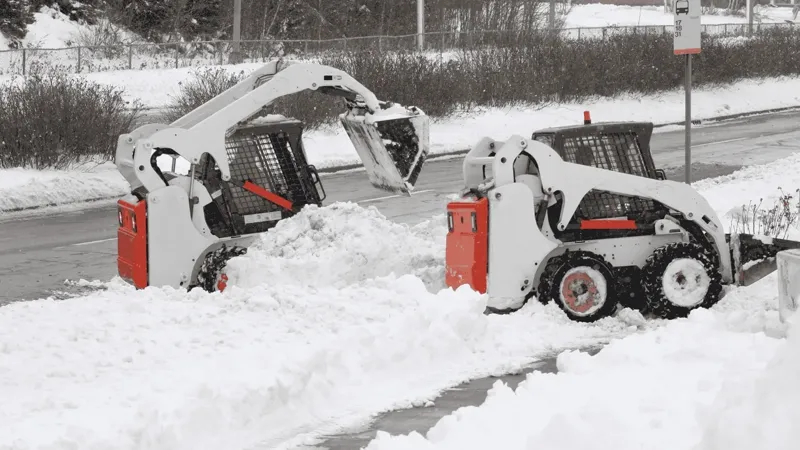
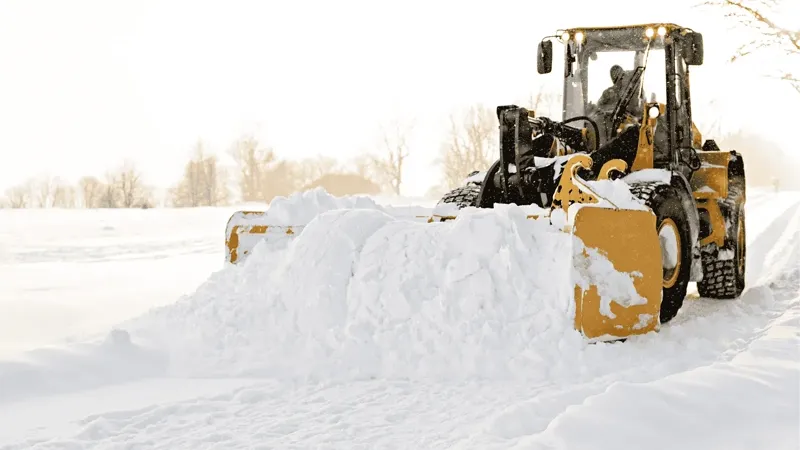
Crews typically open the main drive lanes and turning areas first, then the apron in front of the docks, then trailer parking rows, then employee lots and walks. On large courts, loaders or skid steers with pushers move snow faster than pickup plows and can stack it higher, which matters when stacking space is limited.
Trailer drop lots and dock aprons
Trailer drop lots are the hardest part of the site. Parked trailers leave narrow gaps, their landing gear is easy to strike, and snow drifts between them. Crews work the open lanes with plows and use smaller equipment or hand crews between trailers, coordinating with the yard team to move trailers when a row needs a full clear.
Dock aprons usually slope down toward the building and often have trench drains at the bottom. Snow pushed into the apron melts and refreezes on that slope, and blocked drains turn a dock into an ice rink. Aprons should be cleared to pavement, drains kept open and brine or salt applied so drivers and dock workers have traction where they walk between truck and building.
Sequencing around shifts
Most Lehigh Valley distribution centers run multiple shifts. The biggest risk moments are shift change, when the employee lot fills and empties at once, and the first outbound wave of trucks. A good snow plan names those times and schedules work around them.
In practice that means clearing the employee lot and walks before shift change, holding off on pushing across the main drive lane while trucks are staging, and returning to the truck court between waves. Time-stamped service records for each pass help the facility and the contractor show what was done if there is ever an incident.
- Share your shift schedule and outbound truck windows before the season.
- Name one on-site contact per shift who can move trailers and approve work in the truck court.
- Agree on where yard trucks will be during clearing so equipment is not working blind around them.
Where the snow goes
Stacking is the question that decides whether a big storm is manageable. Snow cannot go in front of docks, in fire lanes, over storm drains, against hydrants or in trailer stalls that will be needed. Piles should sit downhill of walkways so melt does not refreeze across paths.
After storms like the January 2016 blizzard, when Lehigh Valley International Airport recorded 31.9 inches, even large truck courts run out of room. Hauling or relocating piles with loaders and dump trucks should be written into the plan, with an agreed trigger for when it starts, so it is not a negotiation in the middle of the cleanup.
Sources
- Lehigh Valley Public Media: Warehouses in the Lehigh Valley, is the boom over, and what happens next? (August 2024)
- LehighValleyNews.com: Route 100 warehouse conditions get approval from Upper Macungie supervisors
- Hazleton CAN DO: Humboldt Industrial Park
- 6abc Philadelphia: Allentown sets snow record with 31.9 inches during Blizzard of 2016