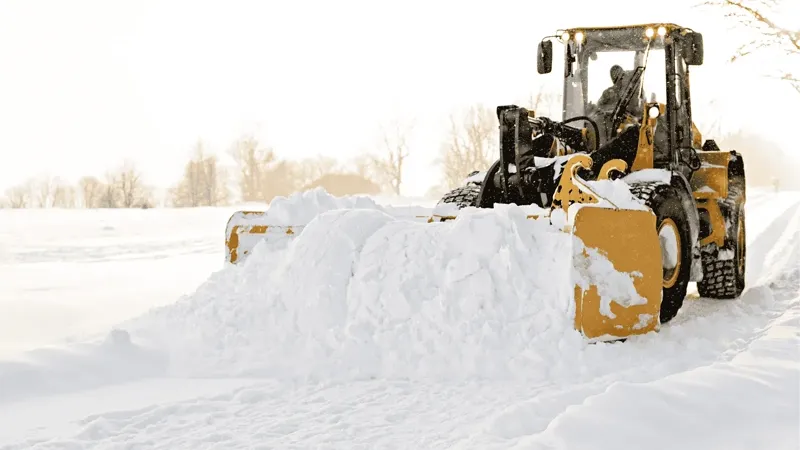
Parking Lot Plowing
Parking lots plowed in a mapped order, with snow stacked away from drains, entrances and accessible spaces.
Learn more
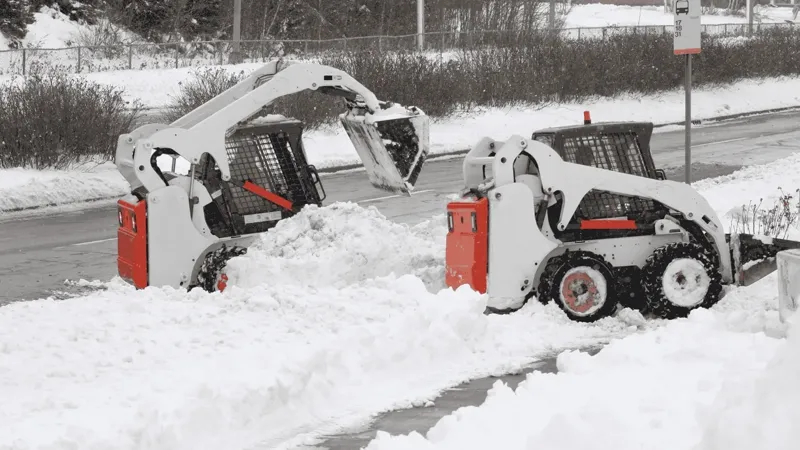
Loaders and dump trucks that move snow off site, or to another part of the property, when piles start eating parking, docks and sight lines.
Frosty Snow Management provides snow hauling and relocation when a property runs out of room to stack. Loaders pick up piles and either move them to an approved area on the same property or load dump trucks to haul the snow to an approved location off site. Hauling is used after large storms or back to back events at shopping centers, apartment complexes, warehouses and tight urban lots across the Lehigh Valley and nearby counties.
Most properties can push snow into a corner and forget about it during a normal winter. The trouble comes in a heavy season, when storm follows storm and cold keeps the piles from melting. Stacking areas fill, piles creep into parking spaces and drive aisles, and loading docks lose room to maneuver.
Snow hauling is the answer when pushing is no longer an option. It costs more than plowing because it ties up loaders, trucks and drivers for hours at a time, which is why the decision should be planned rather than made in a panic when the next storm is a day away.
Relocation is the middle step: moving piles to another part of the same property, such as an unused rear lot or a grass area, before bringing in trucks. On many sites that is enough to get through the season.
Loaders move piles to a secondary area of the same property, such as a rear lot, overflow parking or a grass area. Less expensive and often enough for one heavy stretch.
Loaders fill dump trucks that carry snow to an approved location away from the property. Needed when there is no room left anywhere on site.
Piles are pushed up and back with a loader to recover space and sight lines without moving snow off the property.
We look at how much snow needs to move, where it can go on site, and whether an off-site location is needed.
Retail lots are usually hauled overnight, and warehouses between shift changes or in coordination with the yard.
Loaders work the piles while trucks cycle to the destination, with the area kept closed to traffic while equipment works.
The cleared area is scraped, and pavement in the salting scope is treated so it does not glaze over.
Commercial hauls are documented with times and the work performed, the same as plowing visits.
Snow scraped from parking lots carries salt, sand, oil and litter. It should never be dumped into a creek, a river or a storm drain, including the Little Lehigh, the Bushkill, the Schuylkill in Reading or any of the smaller streams that run through the region. Hauled snow goes to a location that the owner, or the municipality, has approved for it.
Some property owners have land of their own that can take snow. Others need a destination arranged as part of the job. Either way, the destination is settled before the trucks roll, not after.
Timing also matters. Hauling right after a storm, while piles are still loose, is faster than waiting until they have frozen solid for a week. Planning the haul before the next forecast storm keeps stacking room available when it is needed most.
Center city lots, small church lots, bank drive throughs and rowhome block parking areas often have no stacking room at all, and many local codes prohibit pushing snow into the street. On those sites, hauling after a significant storm can be part of the plan from the start rather than an emergency.
At the other end of the scale are the truck courts and trailer lots along I-78, Route 100 and I-81. Snow pushed to the edges of a truck court eats trailer spaces and turning room quickly, and a few storms in a row can leave a yard unable to stage trailers. Relocating or hauling from those yards keeps the operation moving.
When pushing starts costing you something that matters: parking spaces, dock access, safe sight lines or drainage. If more snow is forecast and the stacking areas are already full, hauling before the next storm is usually cheaper than trying to plow around the problem.
To a location the owner or the municipality has approved. It is never dumped into streams, rivers or storm drains, because lot snow carries salt, sand and oil. The destination is settled before the haul begins.
Often, yes. If the property has a rear lot, overflow parking or a grass area that can take snow, loaders can move piles there at a lower cost than trucking. We will look for on-site options first.
We schedule hauls to minimize that, usually overnight for retail and between shift changes or in coordination with the yard for warehouses. The work area is closed off while equipment is moving, and the rest of the lot stays open.
Yes. Hauling and relocation can be written into the scope as an as-needed service with agreed pricing, so it can be called in quickly when stacking areas fill.
Many municipal codes in the region prohibit placing snow in the roadway, because it narrows the street, refreezes into ridges and forces the municipal plows to handle it again. On sites with no stacking room, hauling or relocation is the compliant answer.
Available in 50 towns across Lehigh, Northampton, Berks, Bucks, Montgomery, Monroe, Carbon, Luzerne counties. Some of the busiest:
Parking lots plowed in a mapped order, with snow stacked away from drains, entrances and accessible spaces.
Learn moreTruck courts, dock aprons, trailer lots and employee lots cleared around 24/7 shift changes at big box logistics buildings.
Learn moreApartment complexes and rowhome rental portfolios cleared on one multi-site contract, with a service record for every property.
Learn moreTell us about the property and we will come back with a straight answer on scope and price after a site walk.
Lehigh Valley and eastern PA properties